
The New Opportunity in New Chinese


Consumers are showing strong interest in new Chinese foods, flavors, and concepts, even as American-Chinese restaurants’ U.S. footprint has shrunk, according to Datassential’s New Chinese report.
While American-Chinese cuisine like orange chicken and crab rangoon still leads consumer interest at 65%, the format’s restaurant base has been on the decline, with units down by a net 12.4% since late 2019, according to data from Datassential’s latest Restaurant Landscape report.
“As some of those American-Chinese restaurants lose traction, though, we can look to New Chinese for opportunities to capitalize on everything from traditional Chinese to regional Chinese and Chinese fusion,” the New Chinese report notes.
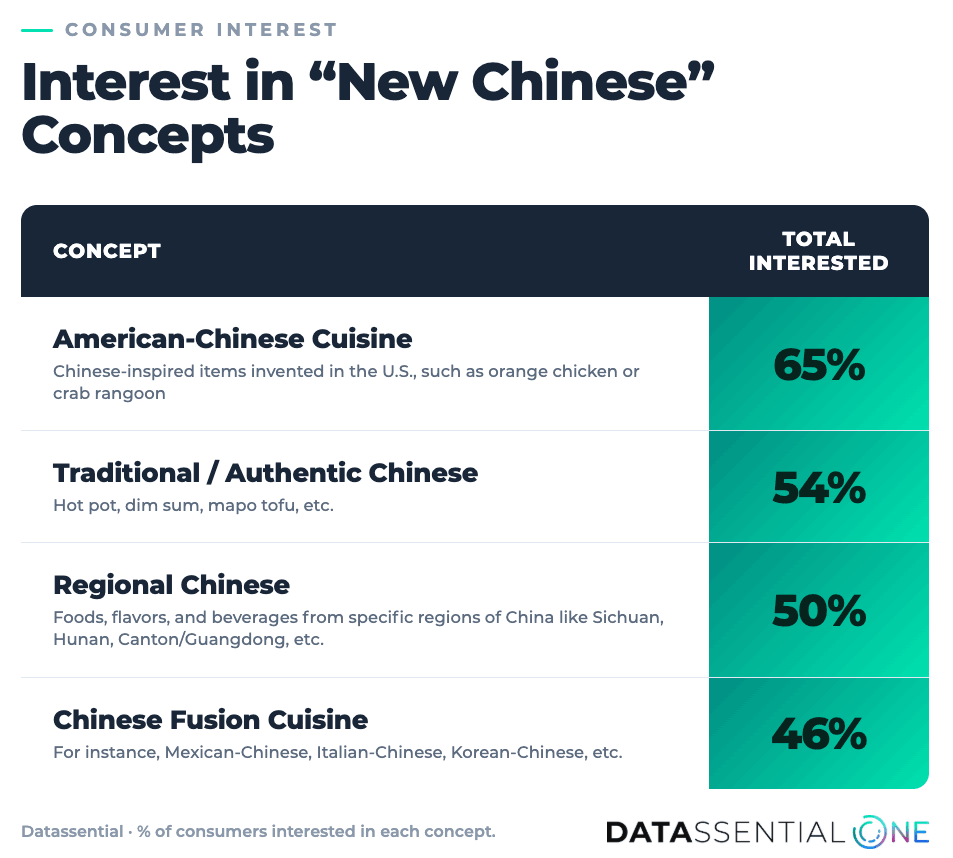
All told, 52% of consumers say they want to see more new Chinese foods, flavors, and concepts at restaurants near them. Among them: traditional and authentic Chinese cuisine, including hot pot, dim sum, and mapo tofu, which draws interest from 54%. Regional Chinese cuisine, tied to specific areas like Sichuan or Canton, follows at 50%. Meanwhile, 46% of consumers showed interest in Chinese fusion cuisine, such as Mexican-Chinese or Italian-Chinese mashups.
Regional Chinese cuisines reveal a gap between interest and awareness. More than half of consumers say they want to try Shandong, Fujian, or Shanghainese cuisine, even though a majority have never heard of any of the three. Shandong posted the highest unfamiliarity rate, at 67%, despite leading the group on trial interest at 53%. Fujian drew 52% interest, with 65% of consumers unfamiliar with it. Cantonese cuisine posted the lowest unfamiliarity rate among the regional cuisines tested, at 46%, and the highest trial rate, at 26%.
Trial gaps suggest significant runway. For example, only 21% of consumers have tried Sichuan cuisine — but among those who have, 79% love or like it, according to Datassential One. Similar patterns hold across other regional Chinese cuisines, where the majority of consumers have never heard of specific regional cuisines like those from Fujian, Zhejiang, or Yunnan, but interest in trying them ranges from 51% to 53%.
Millennials are driving interest across every category. They beat the general population on interest in American-Chinese (73%), traditional/authentic Chinese (64%), regional Chinese (59%), and Chinese fusion (57%) — a pattern that holds across virtually every “New Chinese” concept the report tested.
Chain data reinforces the new Chinese demand. KPOT Korean BBQ & Hot Pot — which pairs authentic Chinese hot pot with an approachable all-you-can-eat format — grew 34.7% in units over the past year and posted 35.3% sales growth, making it one of the fastest-growing chains in the Datassential 500. Independent operators are pushing the category further: Four Kings and Mister Jiu’s in San Francisco are elevating Cantonese fare, Chiko in Washington, D.C., is building a Chinese-Korean fusion menu, and Bonnie’s in Brooklyn is fusing Cantonese classics with American and New York City fare, such as an Italian grinder fried rice.



Comments