
Global Food Culture Moves From Novelty To Mainstream


Global cuisine is no longer a specialty play in American foodservice, but a baseline expectation for most consumers, according to Datassential’s Global, Redefined report.
In general, eighty-nine percent of consumers have dined at a restaurant serving cuisine from another culture, and 86% have tried an international snack or packaged product. Seventy-seven percent have cooked globally-inspired dishes at home, and the same share have shopped at an international grocery store.
“This is not a small segment of adventurous eaters pushing from the margins. It is the vast majority of Americans, building a lived and habitual relationship with global flavors through the places they eat, the food they cook, and the media and entertainment they consume,” the report notes. “For the foodservice and food retail industries, the practical consequence is clear: global cuisine is … a baseline expectation that most consumers bring with them to every dining and shopping occasion.”
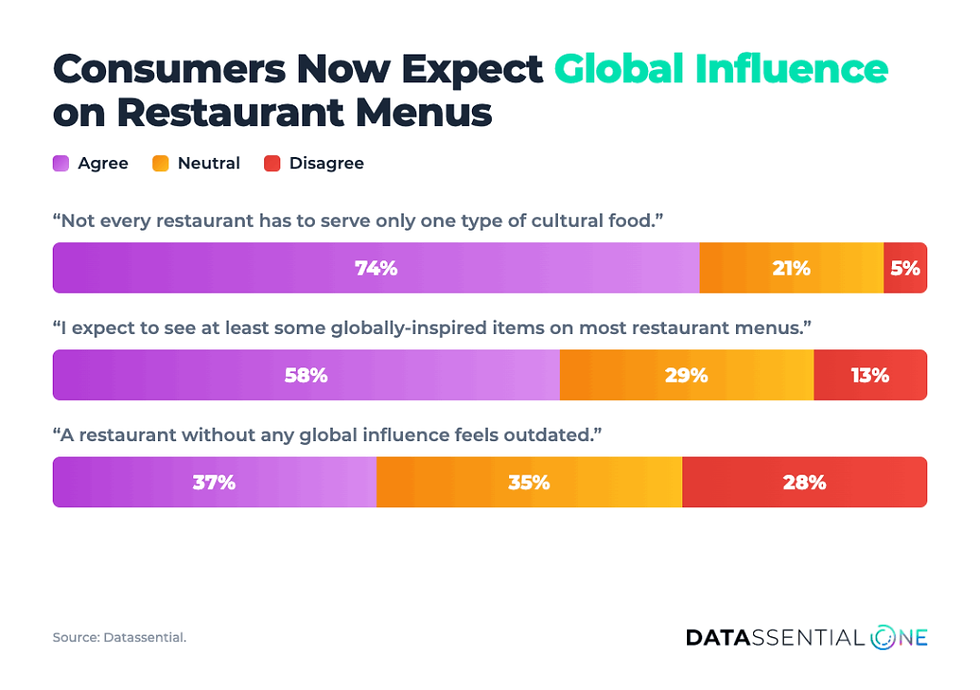
Underpinning that point: nearly three-quarters of consumers agree restaurants don’t need to specialize in one cuisine, and 58% expect at least some globally-inspired items on most menus. For 37% of consumers, a restaurant with no global influence feels outdated.
That openness, however, does come with a slight preference for authenticity over adaptation. Fifty-nine percent prefer global dishes faithful to their cultural origins over Americanized versions, and 54% prefer getting them from a specialist restaurant rather than a generalist one.
Still, consumers don’t see fusion and authenticity as competing values. Two-thirds (67%) see fusion cuisine as an expression of creativity and a natural evolution of food in America, not dilution, and Gen Z (71%) is its most enthusiastic champion. At the same time, 65% say authenticity matters more to them today than it used to, a view held consistently across all four generations.
Younger consumers are also driving how often global cuisine shows up on the table. About 53% of consumers order globally-inspired dishes at restaurants at least monthly, and the gap widens sharply by generation: 34% of Gen Z and 32% of Millennials order them weekly or more, compared to just 4% of Boomers.
According to Datassential’s Next-Gen Global report, 61% of consumers want to see more global foods and beverages at restaurants near them. Millennials (72%) and Gen Z (69%) are especially hungry for broader options at restaurants. Interest in global mashups is especially popular, at 60% among both cohorts.


Comments