
March 3rd, 2026
Low- and No-Alcohol Drinks Deliver on Taste, but Premium Pricing a Challenge

Most consumers who have tried low- and no-alcohol beverages say the category delivers on taste, but they still do not expect to pay a premium for it, according to Datassential’s Low- & No-ABV Beverages report.
Over three-quarters of consumers who have enjoyed a low- and no-ABV beverage agree they taste the same as, or even better than, regular alcoholic drinks. Specifically, 42% of consumers who have tried low- or no-ABV beverages said they taste nearly the same as standard alcoholic beverages. Another 24% said some options are just as good, if not better, while 11% said low- and no-ABV beverages taste better than alcoholic drinks most of the time.
Taste performance, however, does not translate into premium pricing expectations. When drinking away from home, a majority of drinkers who have tried a low-or no-ABV beverage expect to pay the same price or a few dollars less for low- or no-ABV beverages than standard alcoholic equivalents.


The report also provides reasoning for why some consumers still have not tried the category. Among non-triers, one in three said that when they want to cut back on alcohol, they would rather choose a regular non-alcoholic beverage. Others remain skeptical about flavor: 31% said they do not think they would like the taste of low- and no-ABV drinks, and 26% said they do not think they will taste as good as regular alcoholic beverages.
Operator sentiment suggests the category’s momentum is reaching menus as well. Datassential’s Operator Alcohol Menuing report found that while classic and familiar drinks still dominate, more than half of alcohol-serving operators already offer low- or no-ABV options, and 21% said they are interested in adding them.
Survey: Snacks Increasingly Replacing Traditional Meals
March 4th, 2026

U.S. consumers are using snacks as a replacement for traditional meals amid growing financial pressures, according to Datassential’s Table Stakes Tracker report.
Seventy-five percent of consumers said they snacked in place of a standard breakfast, lunch, or dinner occasion at least once in December. Snacking outside of traditional mealtimes is even more widespread, with 87% of consumers reporting doing so in December.
Many consumers also are periodically straying away from traditional meal patterns. Seventy-one percent of consumers said they skipped at least one standard meal in December, and around one in three did so once or multiple times per week. Late-night eating is also prevalent, with 59% reporting they ate a full meal late at night at least once during the month.
These behaviors were reported across the consumer base, though they are more common among younger age groups, particularly Gen Z and Millennials, according to demographic breakouts in the report.

Separate Datassential research shows similar generational differences in snacking frequency over time. More than 40% of Gen Z and over a third of Millennials said they were snacking more frequently in 2025 compared to a year ago, according to Datassential’s 2025 Little Treat Culture report.
Restaurants continue to make snacks available across dayparts. Sixty percent of operators said they offered AM snacking in December, 72% reported offering PM snacking, and late-night service was available at 51% of operations, according to the Table Stakes Tracker. And a greater proportion of operators said AM and PM snacking sales were higher in December than those that reported sales declines.
The report finds that more consumers are opting for snacks in place of traditional meals amid pressing concerns such as the rising cost of living. The prevailing perception among consumers is that foodservice prices were higher in December across restaurant segments, from quick-service to fine dining.
February 5th, 2026
Inflation Pressures Push Consumers to Cut Back on Dining Out
March 5th, 2026

Inflation and rising living costs remain the top concern shaping consumer behavior, prompting diners to pull back on restaurant spending and adopt new money-saving habits.
According to Datassential’s most recent Table Stakes Tracker report, 65% of consumers cited inflation or the rising cost of living as a top concern in December 2025, unchanged month over month. Financial sentiment also remains strained, with 72% of consumers saying they are just getting by, 17% falling behind, and only 11% reporting getting ahead.
That pressure is translating into fewer restaurant visits. Over one-third of consumers said they plan to dine out less often or stop dining out completely in the coming month.
Consumers are also cutting spending across food-related categories. Restaurant meals and dining out led the pullback at 41%, followed by grocery shopping at 33%, while 23% reported cutting back on alcoholic beverages.

Inside restaurants, diners are adjusting ordering behavior to save money. The report found that in the past month, 25% of diners deliberately ordered fewer or no beverages with their meals to save money, and a similar share ordered cheaper menu items than usual. Another 22% chose more affordable venues than usual and ordered fewer or no add-ons, such as appetizers and sides.
Consumers also reported noticing higher prices across major channels, including grocery stores (61%), quick-service restaurants (53%), fast casual (47%), and sit-down restaurants (46%).

Meanwhile, Datassential’s 2026 Industry Forecast further points to early signs of a broad consumer pullback, as rising prices make basic necessities harder to afford — especially for lower-income households. Higher-income consumers remain more resilient and continue to spend, potentially helping keep overall foodservice growth positive in real terms.
Gen Z Revives Classic, Protein-Forward Staples
March 6th, 2026

Gen Z is fueling renewed interest in familiar, protein-forward foods long associated with older generations, according to Datassential’s latest Consumer Preference Shifts report.
Consumer preferences data points to a widening generational split in how Americans engage with food, with each cohort leaning more heavily into items that already resonate with them.
For Gen Z, that means rediscovering everyday staples, such as classic deli salads. Egg salad, tuna salad, and chicken salad are all rising in popularity among the younger generation. Their appeal lies mainly in their practicality and value, given that they are affordable, easy to prepare, and protein-dense.
Gen Z’s interest in retro foods also extends to legacy Chinese-American dishes. Awareness is climbing for menu items like peking duck and pu pu platters, signaling that a new generation is discovering dishes long familiar to older diners.
Other generations, meanwhile, are reinforcing their established tastes rather than branching out.
Boomers, for example, are driving increased awareness of panettone, the seasonal Italian sweet bread that already skews older.

Millennials, meanwhile, continue to anchor their food exploration in global cuisines, posting awareness gains for Malaysian food and rising affinity for Korean dishes. Gen X is similarly doubling down on preferences shaped over time, with the report showing increased awareness of seaweed salad and whipped tofu among those consumers.
C-Store Foodservice Makes Broad Consumer Perception Gains
March 9th, 2026

Convenience store foodservice operators are slowly overcoming some long-standing stigmas, including those related to quality and freshness, according to Datassential’s C-Stores Keynote report.
An increasing number of prepared food and beverage consumers at c-stores are pointing to improvements in a broad range of aspects from the variety of food on offer to the level of value provided.
Variety leads the shift in consumer perception, as 40% of them now say they find a greater amount of food options at c-stores, up from 38% in 2023. That compares to just 5% who say variety has worsened, down one percentage point from three years earlier.
The taste and quality of c-store food, as well as its freshness, have also advanced for roughly one in three consumers, while 30% say cleanliness is improving. These factors are especially relevant in the c-store space: food quality and freshness, combined with a clean and sanitary location, rank as the top motivators that would make consumers choose a c- store over any other alternative for prepared food.

When consumers are making this choice, “convenience will always put c-stores ahead of alternatives in many ways, but improved freshness and quality will help differentiate — and improve value perceptions,” the report says.
Perhaps unsurprisingly, consumers have experienced rising prices at c-stores, as inflation has left a mark across purchasing categories. Prices are the only factor where more consumers (31%) cited a worsening than did improvement (20%).
Newstalgia Continues to Lead Consumer Trials
March 10th, 2026

A resurgence of nostalgic dishes is helping drive consumer trials, with growth in some cases rivaling newer, trendier flavors.
According to Datassential’s Hot Takes: Consumer Preference Shifts report, trials of well-established items such as vodka sauce and espresso martinis are up 7 percentage points from two years ago. That’s among the strongest gains measured in the report, on par with trending flavors like Nashville Hot.
To be sure, trial gains often occur once flavors have reached a certain level of awareness and access, making it easier for consumers to sample them across multiple menus. But newstalgia, where familiar items regain relevance through wider adoption, also is playing a role for some items.
For vodka sauce, which is already known to 65% of consumers and appears on nearly 6% of menus, rediscovery of the Italian classic is being driven in part by its incorporation into nontraditional dishes. According to Datassential’s 2025 Rise & Decline report, the pasta sauce is appearing in items such as chicken sandwiches and Korean rice cakes,
widening how consumers encounter the familiar flavor.

Overall, vodka sauce has grown 17.1% on menus over the past 12 months, and Datassential’s AI-powered Menucast expects it to increase another 17.6% over the next four years.
Espresso martinis, which are known to 63% of consumers, are on an even faster growth trajectory. Once considered a throwback cocktail, the drink has become a standard offering across casual and fine dining, benefiting from renewed interest in coffee-forward flavors and after-dinner drinks, particularly among younger consumers.
The item already appears on 11% of menus, according to Datassential SNAP! data tracking spirit and cocktail menus. Datassential’s AI-powered Menucast projects menu penetration will grow by about 90% over the next four years, reaching roughly 21% of menus.
Pepperoni cups are also posting trial gains, increasing by 7 points over the past two years, despite appearing on just 1.2% of restaurant menus, a gap partly explained by frequent use in limited-time offers. Awareness stands at 56%, with 25% of consumers saying they love or like the item.
Levantine Cuisine Rises Amid Growing Interest in Next-Level Mediterranean
March 11th, 2026

Levantine cuisine, the traditional and vibrant food of the Eastern Mediterranean region characterized by small plates and generous olive oil use, has seen a sharp increase in consumer awareness, according to Datassential’s Consumer Preference Shifts report.
Awareness of Levantine cuisine is up 8 percentage points over the past two years to hit 27%, due in part to growing interest in next-level Mediterranean flavors, making it “an inception cuisine to watch,” the report says.

The cuisine type refers to food traditions from modern-day Lebanon, Syria, Jordan, Palestine, Israel, and parts of Turkey. These flavors build on the broader familiarity of Mediterranean cuisine while introducing more regionally specific dishes and preparations, such as mezze, herb-forward salads and flatbreads.
Restaurants featuring Levantine and Eastern Mediterranean flavors appear across a range of U.S. dining markets. In Washington, D.C., Albi, led by chef Michael Rafidi, offers a Palestinian menu with dishes such as barbecued lamb kebabs and smoked pumpkin baba ganoush, and has received recognition from the Michelin Guide.
In New York City, Café Zaffri features a Mediterranean and Levantine-inspired menu with dishes such as fattoush, a crunchy Lebanese bread salad traditionally made with fried or toasted pita bread, mixed greens, and vegetables like tomatoes, radishes, and cucumbers.
Earlier Datassential research points to Levantine ingredients extending beyond traditional savory uses. A 2024 report highlighted tahini as a Levantine condiment appearing more frequently in sweet applications. It is nut-free, gluten-free, and serves as a substitute for peanut butter. Notably, it contains both protein and fiber, which have become major trends in recent years.
According to Datassential’s Consumer Preferences data, awareness of Levantine cuisine is strongest among younger and food-engaged consumers, aligning with the cuisine’s early-stage awareness gains. Gen Z and Millennials report the highest familiarity, while awareness is lower among older consumers. Engagement also skews toward higher-income and vegetarian diners.
Value Leads Dining Decisions as Price Fatigue Deepens
March 12th, 2026

Value and taste remain the primary lenses through which consumers choose restaurants, even as price fatigue spreads across foodservice and grocery channels, according to Datassential’s latest Table Stakes Tracker Report.
When deciding which restaurant to eat at, consumers most often cite great taste (71%) and value (61%) — a consistent top 2 driver since 2022 — outpacing considerations like service (45%), cleanliness (44%), and convenience (43%).
These priorities continue to reflect ongoing economic pressure. About 65% of consumers listed inflation or the rising cost of living as a top concern in December. In response, 41% reported cutting back on restaurant meals, while 23% say they reduced spending on alcoholic beverages.
Consumers’ definition of value extends beyond price alone. When asked what contributes most to good value away from home, respondents pointed first to great taste, at 54%, followed by low price, at 41%, and ingredient quality, at 33%. The availability of discounts, combo deals, bundles, and consistency ranked lower but remained notable contributors.
Datassential’s The Value Equation report reflects this broader view. More than 80% of consumers agree that good service and a pleasant experience significantly enhance a meal’s perceived value, while 74% say a meal does not need to be cheap to feel like a good value. These sentiments are particularly strong among Gen X and Boomers.
Operators appear to be responding by emphasizing value rather than relying solely on price increases. The Table Stakes Tracker found that 26% of operators focused on value as a profitability strategy in December, compared with 24% who raised menu prices.

At the same time, The Value Equation report notes that more than two-thirds of operators believe consumers are maxed out on price increases, highlighting the need to deliver value through cost management and improvements to the overall dining experience rather than simply adjusting prices. In line with that view, 57% of operators agree that diners prioritize value, or what they get for what they pay, over price alone.
C-Stores Plug Into Media for Food Innovation
March 13th, 2026

Media and social platforms are playing a growing role in how convenience store operators come up with ideas for prepared food and beverage concepts.
Datassential’s C-Store Keynote report shows 35% of c-store operators now use social media for food and beverage inspiration. Traditional media is also gaining ground, now cited by 25% of operators, up 12 percentage points from 2023.
Customer comments and recommendations remain the primary driver of menu ideas for c-store decision makers, cited by 63% of operators. While 40% of such operators still look to what their competition is doing, and 15% keep an eye on trends at restaurants, both of these inspiration sources are less important to c-store operators now compared to 2023.
As media outlets offer insights into shifting consumer tastes and competitor experimentation, operators appear to be “widening their idea net and becoming more tuned in to what resonates outside their own four walls,” the report says.

Shopper behavior patterns align with this shift, as Datassential’s Social Media Sensations report showed that 96% of consumers use at least one social media platform, underscoring the importance these platforms carry in revealing the latest flavor trends.
Media’s growing influence also coincides with rising expectations around digital convenience. Datassential’s 2025 C-Store Segment Guide report showed 19% of consumers value c-stores that offer online and mobile ordering, and 15% cite delivery options as important.
2026 Ushers In Record Protein LTOs
March 16th, 2026

Amid rapidly growing interest in protein-rich foods and beverages, top chain operators kicked off 2026 with a flood of new and returning menu launches calling out the ingredient.
Datassential’s Launches & Ratings recorded 44 new, returning, and limited-time menu offerings featuring protein in January — that’s more than triple the number in the prior-year period and nearly matches the volume of the previous five months combined.
The jump comes as consumers are showing increasing interest and awareness in protein. As Datassential noted in its 2026 Trends report, 52% of individuals said they are prioritizing protein intake this year and 61% expressed interest in high-protein items.
January’s protein-focused offerings were concentrated within the non-alcoholic beverage category — particularly coffee drinks. That largely mirrors operators’ focus across the LTO landscape.
Coffee Bean & Tea Leaf rolled out six beverages featuring protein elements last month, while Tim Hortons and Dunkin’ each had five, and Peet’s Coffee & Tea had three.

Among food types, bowls had an outsized presence — with offerings from Freshii, Chipotle, and Qdoba. There also were multiple sandwich, burrito, and pizza offerings that touted their protein content.
In some cases, protein was front and center in LTOs — such as Blaze Pizza’s new Protein-zza, Papa Johns’ Protein Pizza Crust, and Freshii’s Protein Power Bowl. In other cases, operators touted the protein content of offerings that might not be considered as protein-rich otherwise, such as McDonald’s Hot Honey McCrispy Sandwich and Hot Honey Sausage Egg Biscuit.
Younger Diners Show Strong Increase in Appetizer Consumption
February 17th, 2026

Younger consumers are reshaping the appetizer landscape, driving higher consumption frequency and accelerating demand for diverse flavor experimentation.
According to Datassential’s Appetizers Keynote report, more than 3 in 5 consumers had an appetizer within the last week of being surveyed, but Gen Z and Millennials are significantly more likely to have eaten one in the past few days compared with Gen X and Boomers. Gen Z leads in increased appetizer consumption overall, with 40% reporting eating more appetizers over the past year, followed by 26% of Millennials. Boomers report the lowest increase at 6%.
Monthly consumption patterns reinforce this generational divide. Younger cohorts consistently outpace older ones across nearly every appetizer variety, from fries and chips to wings, fried cheese, and dumplings. For example, 67% of Gen Z consumers and 61% of Millennials have fried cheese at least monthly, compared with just 19% of Boomers.

For Gen Z, social media is the leading source of appetizer ideas, with more than half turning to these platforms for inspiration. For consumers overall, and for every other generation, foodservice menus and offerings remain the primary source of appetizer information.
Younger consumers are emerging as the primary drivers of flavor experimentation, with Gen Z and Millennials showing outsized enthusiasm for global flavors and mashup formats. Interest in Tex-Mex, dumplings, and hybrid appetizers such as Philly cheesesteak egg rolls skews heavily toward these cohorts, while brewpub-style shareables like cheese curds and fried pickles also resonate most strongly with younger diners. Among them, Millennials stand out as the most broadly engaged, consistently posting the highest interest across multiple trending categories.
Rising Food Costs Tighten Margins into 2026
February 18th, 2026

Rising food costs remained the dominant economic challenge for restaurant operators in 2025, reshaping pricing strategies, menu development, and profitability heading into 2026.
According to Datassential’s recent 2025 By the Numbers webinar, nearly 90% of operators said food costs increased over the past year, while only 3% reported any relief. Labor costs added further strain, with 74% of operators reporting increases. As cost pressures mounted, 55% of operators say the economy overall is worse in 2025 than it was in 2024 — a 12-percentage-point increase from the prior year.
Inflation has affected nearly every core menu category. Beef costs rose for 92% of operators, making it the most frequently cited pressure point. Seafood and fresh fruits / vegetables followed closely, each reported as more expensive by 86% of operators. Dairy, poultry, eggs, and prepared foods also recorded widespread increases, limiting operators’ ability to offset inflation through menu substitutions.

These rising costs directly influence how operators plan to grow. Seventy percent identified food and ingredient inflation as the most impactful economic factor on their business, well ahead of labor costs and
reduced consumer spending. Rather than leaning on further price increases, operators are shifting focus toward volume, with 61% saying increasing daily traffic is how they plan to remain profitable in 2026, as opposed to increasing check averages.
Consumer behavior aligns with that strategy as 72% of consumers say they have become more selective about where they spend money on food in 2025. Financial pressure also remains widespread, with 75% of consumers reporting they are just getting by or falling behind, and 49% saying their expenses increased in the past six months.

Rising menu prices partially reflect that struggle. According to Datassential’s Price Monitor, the average price of chicken nuggets at limited-service restaurants has increased 9% over the past 12 months, while milk rose 6% and hamburgers increased 4%.
Prices at full-service restaurants also are up, with a 7% rise in average fish entrée prices over the past 12 months, and 6% increases on beef entrées and chicken wings.
Surveys Show Pent-Up Demand for Signature Dishes
February 19th, 2026

Consumer interest is high in signature dishes at restaurants, particularly in the appetizer and condiment categories, offering untapped potential for operators.
Most consumers (54%) look forward to some sort of signature appetizer away from home, but only 32% of operators offer signature starters, according to Datassential’s latest Appetizers Keynote report.
Signature offerings are often unique recipes that can help define a chef or restaurant, embodying their distinct style and connecting diners to the brand by using special ingredients or techniques to create a memorable experience.
Consumers surveyed by Datassential pointed to a range of signature appetizers as being highly attractive to them, including Sydney Shrooms by Outback, featuring lightly battered and fried mushrooms served with house-made ranch dressing, as well as lettuce wraps from P.F. Chang’s and Cheddar Bay biscuits at Red Lobster.
Condiments, sauces, and dressings are other easy and approachable formats for signature items. A separate Datassential report notes that 3 in 5 consumers are interested in signature versions of at least one of these categories at restaurants. While the consumer interest is present, only 48% of operators say they are known for a signature sauce, dressing, or condiment. Furthermore, nearly all interested consumers said they are likely to purchase retail versions of their preferred signature sauce, condiment, or dressing.
Condiment launches among top U.S. chains continued to gather pace in 2025, with their number rising to 40 from 36 in 2024 and 18 in 2023. Among the 2025 launches were a Signature Brown Gravy LTO by KFC and a Signature Sauce from Popeyes.

At-Home Cooking Rose in 2025, While Dining Out Softened
February 20th, 2026

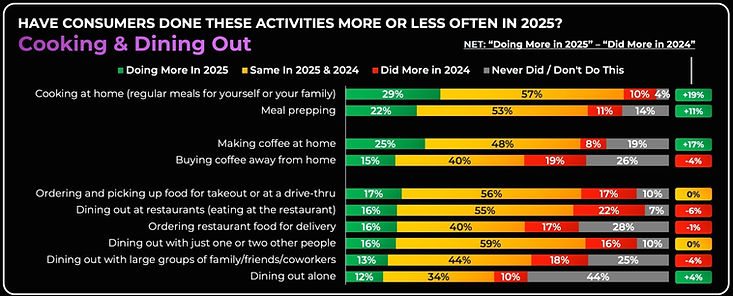
Consumers doubled down on at-home routines in 2025, cooking and brewing coffee more often while dialing back restaurant visits, according to Datassential’s 2025 Year in Review – The Consumer Perspective report.
Nearly three in 10 consumers said they cooked at home more frequently in 2025, compared with 10% who reported cooking at home less often compared to the prior year. Meal prepping also gained momentum, with 22% saying they did it more often and 11% saying they did it less. Coffee habits followed a similar trajectory, as 25% of consumers said they made coffee at home more frequently, while just 8% did so less.
The growing dominance of off-premise occasions also is reshaping what matters when consumers do choose restaurants. Datassential’s 2026 Industry Forecast notes that while service remains a differentiator, it carries less weight than before. That’s because, “if you are eating your meal at home, it does not matter what the on-premise service style is,” the report notes.
Restaurant behavior softened year-over-year. The Year in Review report found fewer consumers increased their restaurant visits in 2025 compared with the year prior. While sixteen percent said they dined out in-person more often in 2025, a higher share (22%) reported dining out less often compared to 2024. Dining out with large groups saw a similar decline, with only 13% reporting an increase in 2025 vs. the 18% who did so more often in 2024.
That pullback also showed up in how consumers defined “affordable luxuries.” While four in five consumers said they made room for affordable luxuries in 2025, the share was lower than in 2024. Dining out, in particular, dropped sharply as an “affordable luxury,” falling to 32% in 2025 from 43% in 2024.
Still, when consumers do spend on in-person restaurant occasions, experience remains a key driver. Datassential’s The Value Equation report found that 59% prioritized enjoying the experience over saving money (32%) or time (9%). The experience-first mindset was especially pronounced among Gen X and Boomers, while Gen Z was more likely to prioritize cost savings.
Global Flavors Reshape College, K-12 Menus
February 23rd, 2026

Global flavors are gaining ground in college and K-12 school dining, reshaping on-site menus as operators expand choices and introduce new international influences, according to Datassential’s State of the On-Site Menu report.
College and university dining continues to lead on menu breadth, with the report showing that the segment has the largest menus and sustained growth over time.
Over the past decade, college and university dining increased items per menu by 31%, the biggest rise among the on-site segments tracked. The sector also posted the highest year-over-year growth in menu size.
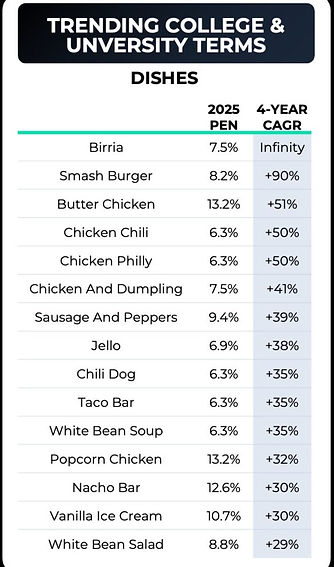
That growth is increasingly tied to increased offering of global flavors. International cuisines gaining traction in college settings include Indian, Turkish, Peruvian, and Filipino. Trending dishes in college dining include birria and butter chicken, while globally inspired menu terms such as bao, elote, and ramen are also gaining ground.
K-12 dining also shows significant movement toward global flavors. The report notes that global dishes gaining in K-12 include chilaquiles, a traditional Mexican comfort food made from fried corn tortilla pieces, and empanadas. Trending terms in K-12 menus show four-year compound annual growth rates higher than 100% for multiple global dishes, including street taco (+145%), al pastor (+109%), and tikka masala (+103%). The growth illustrates a shifting landscape in which K-12 menus are becoming more trend-forward.
Overall, the report suggests students are increasingly open to global flavors and globally inspired dishes. As a result, these flavors are now becoming a more consistent driver of menu development across both college and K-12 foodservice.
The latest update to Datassential’s Kids Meals Menu Adoption Cycle echoed these findings, as international flavors such as orange chicken moved from Proliferation to the Ubiquity stage and teriyaki advanced from Adoption to Proliferation. Meanwhile, global influence has also been seeping into American BBQ, with Cantonese char siu among the global dishes gaining prominence in the U.S.

Plant-Based Growth Persists in On-Site Dining
Fenruary 24th, 2026
Plant-based foods may be losing steam in restaurants, but they continue to gain ground across on-site dining segments, according to Datassential’s State of the On-Site Menu report.
Datassential’s Menu Trends platform shows that while plant-based menu items increased 16% over the past four years, they declined 3% year over year, signaling a broader plateauing across foodservice. Among major U.S. chains, Datassential’s Launches and Ratings platform recorded a modest pullback in plant-based limited-time offers, with 22 introduced in 2025, down from 25 the prior year.

Consumer data reflects similar softening. Datassential’s 2025 Plant-Forward Opportunity report found that in the next year, 28% of consumers plan to order more restaurant dishes featuring legumes and grains as the primary protein source, while 17% intend to order dishes with plant-based meat alternatives. The interest in plant-based dairy and meat alternatives has declined compared with 2023.
Despite the slowdown at restaurants, the State of the On-Site Menu report shows that plant-based offerings continue to post sustained growth across K-12 schools, colleges and

universities, hospitals, and long-term care facilities. The report attributes this divergence to the structural demands of on-site foodservice, where operators serve captive audiences and must accommodate a wide range of dietary needs.
In K-12 schools, plant-based descriptors appear on nearly all menus, reaching 99% penetration and posting a four-year compound annual growth rate of 37%. While plant-based items may no longer be accelerating in retail and restaurant settings, the report describes them as “essential” in K-12 foodservice, where dietary inclusion is a baseline requirement.
Colleges and universities show a similar pattern. Plant-based descriptors there have also reached 99% menu penetration, with a four-year CAGR of 104%, making them the fastest-growing menu attribute in the segment. These callouts increasingly appear alongside other strategies designed to appeal to a broad student population, including the expansion of global cuisine offerings and menu customization.
Healthcare foodservice also continues to expand plant-based presence. Hospitals report roughly

88% penetration for plant-based descriptors, with a four-year CAGR of 32%. Long-term care facilities show comparable gains, with plant-based reaching 92% penetration and a four-year CAGR of 27%, despite contraction across most top dishes at such facilities.
Rather than removing plant-based offerings, on-site operators appear to be refining their role by segment. While growth may be slowing in traditional restaurant channels, plant-based foods remain a core component of on-site menu planning, driven by inclusivity, dietary accommodation, and the need to offer something for everyone.
Health-Forward Eating Gained in 2025 Despite Inflation Pressure
February 25th, 2026

Health-focused eating increased among U.S. consumers in 2025, even as inflation and rising food prices remained a top financial concern, according to Datassential’s 2025 Year in Review: The Consumer Perspective report.
About one in four consumers said they ate more healthy foods in 2025 than in 2024 (with Gen Z reporting the largest increase), compared to only 10% who said they ate more healthy food in 2024 than last year.

The report shows that health-forward behavior extended beyond food choices. Around 35% of consumers said their nutrition and diet improved in 2025, alongside a similar percentage reporting gains in physical health and fitness. Nearly one-third reported drinking more water, while more than a quarter exercised or played sports more often compared with the prior year. Mental well-being also improved for more than 30% of consumers.
The uptick in healthy eating and habits comes even as inflation and the rising cost of living ranked as the most pressing societal concern, cited by 65% of consumers. More than half also said they had reached their limit and would be unable to absorb further price hikes.
Consumers particularly recognized that food and beverage prices rose across nearly all major categories. More than three-quarters of consumers noticed higher prices for fresh produce, poultry, dairy, and snack foods, while nearly 70% reported increases for beverages such as coffee, juice, and soda. Beef saw the highest level of perceived price increases among all food categories.
Despite these pressures, eating healthier remains a top consumer priority heading into 2026, as 42% plan to eat healthier this year, 47% plan to exercise more, and 24% intend to cook at home more often.
Value-Focused Menu Innovation a Key 2026 Priority for Operators
February 26th, 2026

Value-focused items and promotions will be a key priority for operators this year, ranking second only to core menu items as a focus area for culinary innovation, according to Datassential’s 2025 Year In Review: The Operator Perspective report.
Nearly half of operators say they plan to focus on strengthening core menu items in 2026. At the same time, about 30% identified value-driven menu development as a top priority, placing value-focused promotions ahead of trending items such as better-for-you offerings (29%), desserts and sweet treats (23%), and non-alcoholic beverages (11%).

Most operators (56%) say they do not plan significant changes to their menu development initiatives in 2026, while 37% expect to ramp up culinary innovation efforts and 7% plan to scale back.
Last year, operators conveyed an increased focus on value as a strategy to drive profitability amid heightened labor and food cost challenges. Fast-casual operators in particular ramped up their combo and value offerings in 2025, embracing a space historically dominated by the quick-service segment.
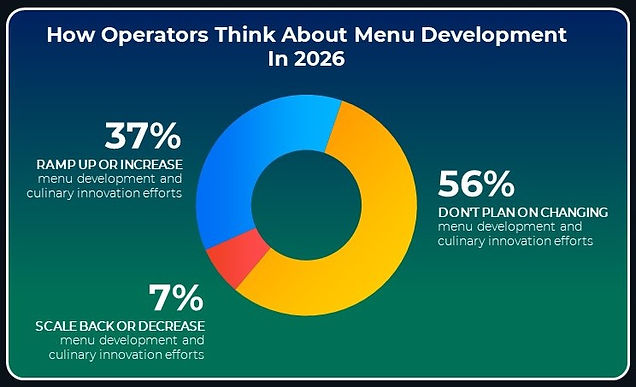
In the latest 2025 Year In Review – The Operator Perspective report, segment-level data shows variation in menu innovation focus. Fast casual, midscale, casual dining, and colleges and university operators are among the most likely to say they plan to focus on value-driven items and promotions in 2026.
Recent Datassential research also shows that quick-service chains have already been leading the industry in value activity. QSRs have consistently introduced far more combo and value meals than any other segment over the past several years, according to Datassential’s The Value State report. That continues earlier Datassential research pointing to increases in value menu performance at major chains such as Wendy’s and Denny’s in 2024.

Fast casual, midscale, and casual dining chains, by comparison, are beginning to expand their output, with fast casual showing a 79% year-over-year increase in value meal launches. That broader pattern helps explain why QSR operators were not among the segments most likely to say they plan to focus on value-driven menu development in 2026.
Cost pressures remain widespread across the industry. Nearly two-thirds of operators said ingredient and supply costs worsened in 2025, and most reported increases in both food and labor costs over the past year.
Health-Forward Eating Gained in 2025 Despite Inflation Pressure
February 27th, 2026

The number of restaurant units in the U.S. has never been higher — it’s also never been as diverse.
According to Datassential’s latest U.S. Restaurant Landscape report, there were nearly 859,000 active units as of October 2025. That’s up about 2% from the prior-year period and nearly 6% above the post-pandemic low, hit in February 2022. It’s also slightly above the pre-pandemic high-water mark of November 2019.
But much of that recovery has been driven by several international cuisines with outsized growth rates — albeit from relatively low base sizes.
The number of Indian restaurants in the U.S., for example, is up nearly 10% year over year and has risen roughly 32% from six years ago. African, Korean, and South American restaurants have posted similarly strong increases, rising by as much as 38% since October 2019. And growth rates among restaurants specializing in Caribbean, Mexican and Mediterranean are each up by about 11% or better.

Over that same time, many traditional or familiar U.S. cuisine categories have lost ground. Total active pizza units are down nearly 11% from late 2019, translating to roughly 8,900 fewer units. Along the same lines, steakhouse, BBQ, and sandwich/deli restaurants have shrunk by more than 11%, while seafood and burger joints are down around 6%.

And while American cuisine restaurants managed a 1.7% year-over-year increase as of October 2025, the total number of active units is still nearly 3% lower than before the pandemic.
But despite those losses, many of the long-standing staples of the U.S. foodscape continue to represent the overwhelming majority of active restaurants. American cuisine units still account for roughly 25% of all units, while the combined total of units specializing in pizza, burgers, sandwiches, seafood, and BBQ represent more than another quarter.
And to be sure, growth among international cuisines has not been universal. The number of active Chinese restaurants, for example, is down 14% compared with six years ago. Active units for Italian (down 9%), French (down 3%) and other European cuisine (down 9%) have also shrunk.
By the same token, some traditional cuisines have also shown above average growth. The number of coffee/bakery units, for one, has jumped some 26% from October 2019, and Southern cuisine is up around 16%.
The increasing diversity within the restaurant landscape largely mirrors a broader shift in consumer interest. Datassential’s Global Flavors report found that more and more consumers are eating foods with Asian, European, Latin American, Middle Eastern, and African influence. And more than two-thirds prefer globally influenced cuisine at restaurants that specialize in that food.
Datassential’s 2026 Trends report showed that global ingredients could be the top flavors for this year, with items like Peruvian black mint and Senegalese ataya tea garnering high consumer interest. Beyond that, global flavors have made a mark on American BBQ, and have also gained prominence on school and university menus, all amid a demographic shift to a more ethnically diverse population in the U.S.